What is behind image to text technology of OCR?
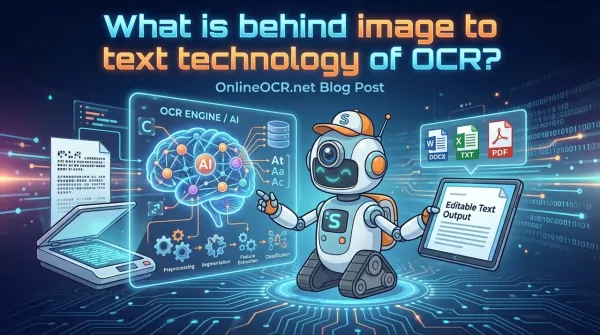
Ever wished you could just grab text from a photo, a scanned document, or even a street sign?
That's not magic, it's the incredible power of Image-to-Text technology, better known as Optical Character Recognition (OCR)!
This isn't just some tech jargon; it's a game-changer that's completely transformed how we interact with visual information. For students digitizing notes, researchers sifting through archives, developers building smart apps, or home users organizing old receipts, OCR is the unsung hero. It empowers machines to pluck text right out of images, making printed content instantly accessible, editable, and searchable. In our increasingly digital world, where physical documents are rapidly becoming digital data, OCR isn't just useful—it's absolutely essential, saving us all precious time, effort, and resources.
The journey of OCR is a fascinating one, stretching back to the early 20th century, but it truly started to shine in the 1950s and 60s. Imagine those early systems: clunky, demanding text be printed in a very specific, standardized font. They were like picky eaters, only recognizing what they knew perfectly! Setting them up was a whole ordeal, often requiring documents to be tailor-made for recognition. But as computer vision started to "see" better and machine learning began to "think" smarter, OCR evolved from a rigid rule-follower to a versatile interpreter. Today's OCR systems are incredibly sophisticated, capable of deciphering a wild array of fonts, tackling even messy handwriting, and extracting text from complex images like graphs, charts, or those tricky, skewed scanned documents. It's a testament to how far we've come!
🚀 Stop Retyping, Start Editing! 🚀
Looking for FREE Online OCR Converter? Use OnlineOCR.net!
If you're looking for a quick, "no-install" solution to round out your toolkit, OnlineOCR.net is a fantastic web-based alternative to built-in Windows tools.
It’s particularly useful when you're working on a guest computer or simply don't want to clutter your system with extra software.
Why choose OnlineOCR.net as free Image to Text converter?
The service supports over 46 languages and allows you to convert images or PDFs directly into editable Word, Excel, or Plain Text formats.
While the free tier limits you to 5 images per hour, its accuracy with standard fonts is impressive, making it a reliable "Plan B" for those one-off extraction tasks that require a bit more finesse than a simple screenshot.
📥 3 Simple Steps to Freedom:
- Upload your image or PDF.
- Select your language and output format (Docx, Xlsx, or TXT).
- Convert and download your editable file!
👉 Try it for FREE now at OnlineOCR.net 👈
So, what's the secret sauce behind modern OCR's superpowers? It's all thanks to the incredible leaps in machine learning, artificial intelligence, and deep learning algorithms. Forget those old rule-based systems that just matched predefined patterns; today's OCR is powered by neural networks, especially the mighty Convolutional Neural Networks (CNNs). For you developers and researchers out there, this means OCR systems now interpret text, learning from vast amounts of data to accurately detect and transcribe with mind-blowing precision. These AI brains can handle almost anything: poor image quality, multiple languages, and even those funky, stylized fonts that used to stump everything. This evolution has made OCR a reliable workhorse for real-world applications, from digitizing fragile historical documents for researchers to extracting data from invoices for businesses, and yes, even letting you snap a photo with your smartphone and instantly grab the text!
OCR isn't just a cool tech trick; it's an indispensable tool woven into the fabric of critical sectors like healthcare, law, finance, education, and government. In healthcare, for instance, OCR is a lifesaver, digitizing mountains of paper medical records. Imagine doctors and nurses instantly accessing patient info instead of sifting through files – that's better patient care and streamlined workflows! For legal eagles, OCR means extracting crucial information from contracts or court rulings in seconds, not hours, making legal research lightning-fast. And in finance, it's automating data entry for invoices and receipts, slashing human error and speeding up transactions. It's all about making these vital industries more efficient and accurate, benefiting everyone involved.
Hey students! Ever struggled with an inaccessible textbook or wished you could instantly pull a quote from a research paper without typing it out? OCR is your academic ally! It's revolutionized access to learning materials, especially for students with visual impairments, by transforming scanned books and images into editable, digital text. This creates truly inclusive learning environments. Plus, for anyone needing to extract specific information from lengthy documents, OCR saves you from tedious manual transcription, letting you focus on understanding, not typing. It's a convenience that makes OCR an invaluable tool in today's educational landscape.
Beyond the classroom and the boardroom, OCR is quietly working behind the scenes in government agencies, making our public services smoother. Think about all those birth certificates, passports, voter registration forms, and tax documents. OCR helps digitize and organize these records, improving data management and making information more accessible for citizens. For example, when you submit a scanned form or even a handwritten application, OCR is often the tech converting that information into machine-readable text, making tracking and analysis much easier. It’s all about a more efficient, transparent government for everyone.
Now, for the fun part that touches almost everyone: your smartphone! One of the most exciting applications of image to text technology is right in your pocket. OCR is deeply integrated into mobile apps, letting you extract text from photos in real-time. Ever used Google Lens or Microsoft Office Lens to snap a picture of a business card, a street sign, or a restaurant menu and instantly copy the text? That's OCR doing its magic! These apps leverage OCR's power to give you a fast, efficient way to interact with the printed world around you. For professionals on the go, travelers navigating new cities, or students quickly digitizing notes, the ability to capture text in real-time opens up a world of possibilities. Your phone isn't just a camera; it's a text-grabbing wizard!
But let's be real, even with all these amazing advancements, OCR isn't perfect (yet!). For you developers and researchers, these are the exciting challenges to tackle! One of the biggest hurdles is accuracy, especially when images are blurry, distorted, or have background noise. Imagine trying to read a smudged note – that's what OCR faces! Skewed text, unusual symbols, and especially handwritten or cursive text still pose significant challenges. While modern systems have made incredible strides, achieving 100% perfect recognition across all scenarios is still the holy grail we're chasing.
Another fascinating challenge is language support. The world speaks many languages, and OCR is constantly learning! While systems can recognize many languages, complex or non-Latin scripts like Arabic, Chinese, or Hindi still present unique difficulties. Plus, intricate punctuation or grammatical structures can sometimes trip up even the best systems, leading to incorrect transcriptions. Multilingual OCR is a booming area of research, driven by a global demand for broader language and writing system support. The good news? Ongoing advancements in AI and machine learning are constantly pushing boundaries, with more sophisticated models emerging that can handle an ever-wider variety of languages, scripts, and document types.
And let's not forget a critical aspect for everyone: security and privacy. Since OCR systems often handle sensitive data—think personal information or confidential documents—it's paramount that this data is protected. For developers, implementing robust encryption and secure processing protocols is non-negotiable to prevent potential breaches. We're seeing a growing trend towards OCR systems designed to run locally on devices, meaning your sensitive information is processed right on your phone or computer, reducing the risk of data being transmitted over the internet. This approach significantly enhances privacy and security, giving users peace of mind.
Strap in, because the future of image-to-text technology is incredibly exciting! For students dreaming of future tech careers, and developers looking for the next big thing, this is where it gets wild. With deep learning algorithms and AI models constantly evolving, expect OCR systems to become even more accurate, versatile, and lightning-fast. Imagine augmented reality (AR) and virtual reality (VR) systems leveraging OCR to instantly identify and extract text from the physical world, seamlessly integrating it into your virtual experiences! Or picture OCR blending with voice recognition, allowing you to interact with text using both sight and sound. The possibilities are truly limitless.
Moreover, the rise of cloud-based OCR services is a game-changer for businesses and individuals alike. No more needing specialized hardware or software! Cloud OCR platforms let you process documents and images from any device with an internet connection. For teams, this means real-time collaboration and document sharing, making projects requiring text extraction and manipulation smoother than ever. It's OCR, now accessible and collaborative, right in the cloud!
In conclusion, Image to Text technology, powered by the marvel of OCR, has profoundly impacted nearly every industry, from healthcare to education, government to finance. It's made digitizing and interacting with printed text easier, boosting efficiency, accessibility, and data management for everyone. While challenges in accuracy, language support, and security persist, the relentless march of AI and machine learning is poised to conquer these hurdles, making OCR even more powerful and versatile. As this incredible technology continues its evolution, expect it to play an increasingly central role in our digital transformation, revolutionizing how we interact with and manage textual information in ways we're only just beginning to imagine.
👉 Try it for FREE now at OnlineOCR.net 👈