What is OCR and why do you need it?
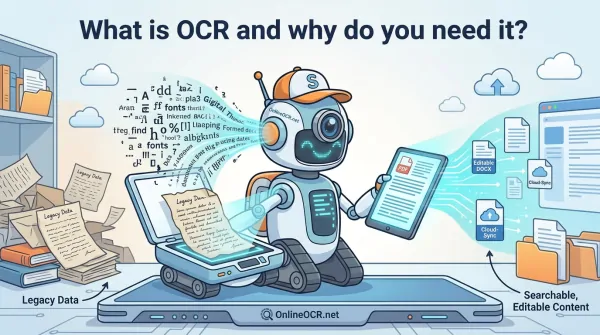
Optical Character Recognition (OCR, can be found on Google as online OCR converter) is a technology leveraging automated data extraction mechanisms to transform textual content embedded within images into a machine-readable data format.
Often termed text recognition, OCR software processes input from diverse sources such as scanned documents, camera-captured images, and image-only PDF files. The core functionality involves character segmentation, word reconstruction, and sentence assembly from the visual input, thereby facilitating programmatic access and manipulation of the extracted textual data. This process significantly mitigates the overhead associated with manual data transcription.
OCR systems are architected as hybrid solutions, integrating hardware components with software modules to digitize physical, printed documents into machine-readable text. Hardware elements, including optical scanners or dedicated processing units (e.g., specialized circuit boards), perform the initial image acquisition. Subsequent advanced processing, such as image analysis and character interpretation, is typically managed by software algorithms.
Modern OCR implementations frequently leverage artificial intelligence (AI) frameworks to enhance recognition capabilities, enabling advanced Intelligent Character Recognition (ICR) for tasks such as language identification and handwriting analysis. Enterprise applications often utilize OCR pipelines to convert legacy physical documents (e.g., legal, historical archives) into searchable and editable PDF formats, providing functionality analogous to word processor-generated content.
Stop Retyping, Start Editing!
Looking for FREE Online OCR Converter? Use OnlineOCR.net!
If you're looking for a quick, "no-install" solution to round out your toolkit, OnlineOCR.net is a fantastic web-based alternative to built-in Windows tools.
It’s particularly useful when you're working on a guest computer or simply don't want to clutter your system with extra software.
Why choose OnlineOCR.net as free online OCR tool
The service supports over 46 languages and allows you to convert images or PDFs directly into editable Word, Excel, or Plain Text formats. While the free tier limits you to 5 images per hour, its accuracy with standard fonts is impressive, making it a reliable "Plan B" for those one-off extraction tasks that require a bit more finesse than a simple screenshot.
3 Simple Steps to Freedom:
- Upload your image or PDF.
- Select your language and output format (Docx, Xlsx, or TXT).
- Convert and download your editable file!
Evolution of Text from Image
In 1974, Ray Kurzweil founded Kurzweil Computer Products, Inc., pioneering an omni-font OCR solution capable of recognizing text across diverse typographic styles. This technology was subsequently applied to develop a machine learning (ML)-driven assistive device for the visually impaired, featuring text-to-speech synthesis. By 1980, Xerox acquired the company, aiming to commercialize advanced paper-to-digital text conversion systems.
OCR technology gained significant traction in the early 1990s, primarily for the digitization of historical archives. Subsequent advancements have led to substantial improvements in recognition algorithms and system performance. Contemporary OCR solutions achieve near-perfect accuracy rates and are capable of automating sophisticated document-processing workflows.
Prior to the widespread availability of OCR, digital document conversion necessitated manual data re-entry, a process characterized by significant time consumption, inherent inaccuracies, and potential transcription errors. Currently, robust OCR services are broadly accessible. For instance, the Google Cloud Vision OCR API facilitates document scanning and digital archival directly from mobile devices.
OCR Operational Mechanics
OCR software orchestrates the transformation of physical document artifacts into editable, digital text via scanning hardware. Implementations of OCR functionality can manifest as standalone applications, integrated through an OCR application programming interface (API), or consumed as a web-based service.
- Image Acquisition: This initial phase involves capturing document pages, followed by the OCR engine's conversion of the digital input into a binary (two-color or black-and-white) representation. The resultant bitmap undergoes analysis to differentiate foreground (dark portions, identified as potential characters) from background (light areas).
- Preprocessing: The acquired digital image undergoes a cleaning process to eliminate noise and extraneous pixels. This stage encompasses operations such as deskewing (correcting rotational misalignment from scanning), removal of graphical artifacts (e.g., rules, boxes embedded in the original print), and initial script detection.
- Text Recognition: Foreground elements (dark portions) are processed to identify alphanumeric characters and symbols. This stage typically employs a segmentation strategy, analyzing individual characters, words, or text blocks. Character identification is performed using one of two primary algorithmic approaches: pattern recognition or feature recognition.
- Pattern Recognition (Template Matching): The OCR engine utilizes a pre-trained dataset of character templates across diverse fonts and formats. Recognition occurs by comparing segmented characters from the input image against these stored glyphs (unique combinations of shape, scale, and font). This method's efficacy is contingent upon the input characters matching a font present in the training corpus. The combinatorial explosion of fonts and character sets across global languages (e.g., Arabic, Chinese, English, French, German, Greek, Japanese, Korean, Spanish) renders comprehensive template training computationally intensive and resource-demanding.
- Feature Recognition (Detection or Extraction): This approach is employed when the OCR system encounters fonts not present in its explicit training data. It applies a set of predefined rules and heuristics to identify intrinsic structural features of characters, such as the count of angled lines, line intersections, loops, or curves. For instance, the character "A" might be defined by two intersecting diagonal lines and a horizontal crossbar. Upon successful identification, the character is encoded into its corresponding American Standard Code for Information Interchange (ASCII) representation, enabling subsequent digital processing and manipulation.
- Layout Recognition: Advanced OCR systems incorporate document structure analysis. This module segments the page into distinct logical elements, including text blocks, tables, and embedded images. Further hierarchical decomposition involves segmenting lines into words, and words into individual characters. Post-character segmentation, the system performs pattern matching against character templates. Following the evaluation of potential matches, the system outputs the recognized textual content, preserving its structural context.
- Post-processing: The extracted textual data is persisted as a digital file, typically in an editable format or as a searchable PDF. Certain OCR implementations maintain both the original input image and the post-OCR output, facilitating validation and comprehensive document management workflows.
OCR Classification and Methodologies
OCR pdf to word online converters and systems can be categorized into four primary types, reflecting increasing levels of algorithmic sophistication:
Simple OCR: This foundational approach performs character-by-character pattern matching, comparing segmented input characters against a predefined set of stored glyph templates. Due to the vast permutations of fonts and language-specific character sets, its applicability is constrained to documents utilizing known, trained typographies.
Optical Mark Recognition (OMR): Specialized for detecting and interpreting non-textual graphical elements, such as checkboxes, form-based marks (e.g., survey bubbles, signatures), logos, symbols, and watermarks. Identification is achieved via template matching against stored image patterns, similar to simple OCR's methodology.
Intelligent Character Recognition (ICR): ICR extends OCR capabilities by integrating artificial intelligence (AI) paradigms. Leveraging machine learning (ML) or deep learning techniques, ICR systems develop adaptive recognition models through iterative training. A neural network architecture typically analyzes textual input, identifying distinctive character attributes such as curvilinear structures, line intersections, and topological features.
Intelligent Word Recognition (IWR): Representing an advancement over character-level ICR, IWR systems employ AI models trained for holistic word recognition from a single image segment. This word-level processing paradigm significantly enhances recognition speed and contextual accuracy.
Advantages of OCR Implementation
Implementing OCR technology yields several strategic advantages, including the capability to:
- Optimize operational expenditures by minimizing or eliminating manual data entry overhead.
- Enhance process efficiency through automated ingestion of physical documents and forms, accelerating data retrieval and analysis via searchable digital repositories.
- Facilitate automated document classification, content extraction, and preprocessing for downstream text mining applications.
- Reduce physical storage costs associated with paper-based archives.
- Establish centralized, secure digital data repositories, mitigating risks associated with physical document loss (e.g., disaster recovery, unauthorized access).
- Improve data accessibility and compliance for accessibility standards, benefiting visually impaired users.
- Elevate service quality by ensuring personnel have immediate access to current and validated information.
OCR Application Scenarios
A primary application of OCR involves the transformation of physical printed documents into machine-readable text formats. Post-OCR processing, the extracted text becomes amenable to manipulation within standard word processing environments (e.g., Microsoft Word, Google Docs). This capability extends to diverse industry verticals, including education, finance, healthcare, and logistics/transportation, accelerating workflows for tasks such as processing and retrieving loan applications, patient records, insurance claims, labels, invoices, and receipts.
OCR frequently operates as an embedded technology, underpinning numerous ubiquitous systems and services. Beyond overt applications, critical but less visible use cases encompass data-entry automation, assistive technologies for the visually impaired, and document indexing for search engines. Specific implementations include processing passports, license plates, invoices, bank statements, check processing and transcription, business card digitization, and Automatic Number Plate Recognition (ANPR).
OCR facilitates the optimization of big-data analytics pipelines by transforming unstructured paper and image-based documents into structured, machine-readable, and searchable PDF formats. The extraction and retrieval of critical information from such documents necessitate the application of OCR where native text layers are absent.
Inegrating OCR text recognition capabilities allows scanned documents to be incorporated into big-data ecosystems, enabling programmatic extraction of client data from financial statements, contracts, and other critical printed materials. This automates the ingestion process, replacing manual examination and data entry with an efficient, automated input stage for data mining workflows. OCR software is engineered to extract textual content from image files, persist it as text data, and supports a range of input formats, including JPG, JPEG, PNG, BMP, TIFF, and PDF (can be found on Google as image to word, pdf to excel ocr, pdf to word ocr, etc.).
Contemporary Advancements in OCR
OCR technology has evolved substantially since its initial commercial deployments in 1974, with ongoing advancements. Modern, high-performance OCR solutions are capable of extracting critical data and insights from documents even under suboptimal input conditions , including diverse font styles, low-resolution imagery, challenging illumination from mobile capture, and complex color/background variations.
The integration of computer vision and natural language processing (NLP) techniques, coupled with enhanced information representation and model optimization, empowers contemporary OCR systems to achieve state-of-the-art document understanding. Key enhancements include sophisticated layout analysis, accurate reading order detection in complex documents, and the interpretation and representation of visual elements (e.g., charts, diagrams). Furthermore, certain OCR platforms now leverage generative AI models to accelerate document data structuring. This demonstrates the continuous innovation within a mature technological domain.